Hand-knotted in Pakistan · Since 1972
Latif Enterprises
Click anywhere to begin
Hand-knotted in Pakistan · Since 1972
Latif Enterprises
Click anywhere to begin
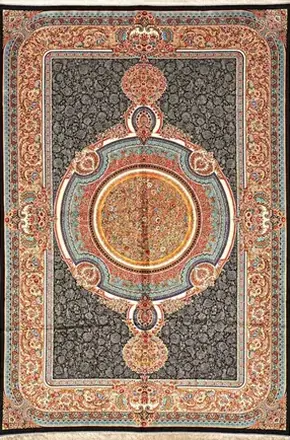
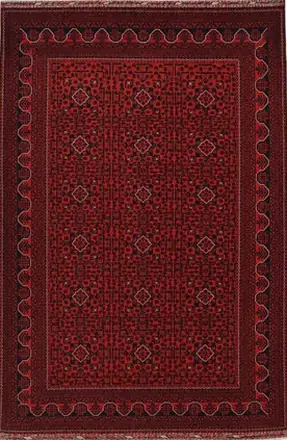
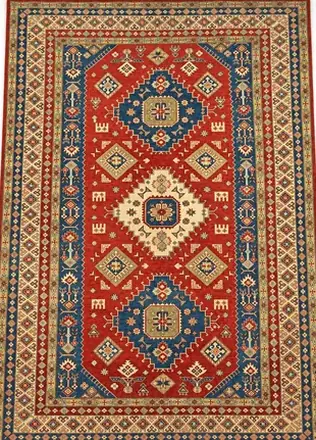
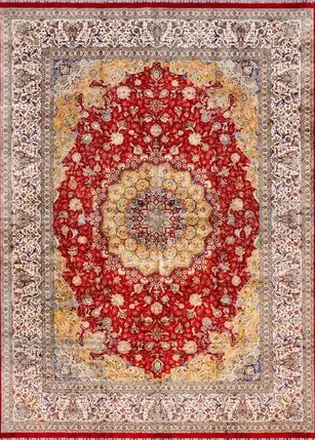
A hand-knotted wool rug from Latif Enterprises, Lahore: a deep madder red field with an eight-pointed central medallion in ivory and indigo, and a triple running border.
Hand-knotted in Pakistan · Since 1972
Wool and silk on our own looms, since 1972, by weavers we have worked with for years.
View the collectionEmail: info@carpet-latif.com Phone: +92 42 3636 3140
Scroll
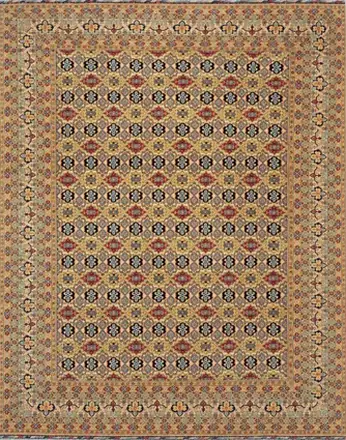
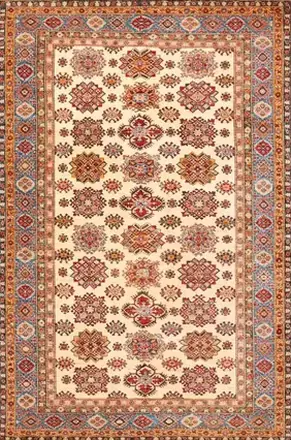
A wool kilim from Latif Enterprises lying back behind the four figures: row on row of small stepped diamonds in saffron, coral, teal and plum on an ivory ground, inside a wide sage-green border.
Four numbers
Since 1972 we have hand-knotted rugs in Lahore on our own looms, in our own dye house, washed and finished on our own floor.
A hand-knotted rug on a madder-red field set with rows of small ivory, indigo and gold medallions inside a wide ivory border, shown rolled and then unrolled across the floor.
Chapter One · 1972
In 1972 the trade in Lahore was buying machines that were cheaper and faster than any pair of hands. Abdul Lateef Malik strung another hand loom instead.
A hand-knotted carpet takes months, and you cannot make more of them by buying another machine. What you get for the wait is a rug that outlives the person who bought it.
Work he would not put the family name on went back out of the door, and for years that kept the workshop smaller than it needed to be. The buyers who stayed through those years are the ones we still weave for.
Three identical hand-knotted rugs from the same Lahore looms, laid side by side: a mint-green field with a column of stepped gold and red medallions, inside a wide madder-red border of ivory rosettes.
Chapter Two · The growth
We grew by word of mouth. A rug sold in Lahore was recommended in Karachi. A sample sent to a buyer abroad came back as a standing order. Nobody here has ever written an advertisement.
When demand rises, the easy move is to thin the wool, tie faster and hope nobody notices. The second generation bought better wool, kept natural dyeing while most of the industry was dropping it, and hired master weavers from families that had woven for generations.
Most of this industry hands the work to brokers and hopes for the best. We brought every stage that touches the rug under our own supervision. That is why the quality has held.
Two hand-knotted portrait rugs from the Latif Enterprises workshop in Lahore: Abdul Lateef Malik, founder and Patron-in-Chief of the Pakistan Carpet Manufacturers and Exporters Association, and Malik Muhammad Azam, Chairman Task Force and Chairman of the Pakistan Tanners Association, each woven in wool on a warm ivory ground inside a narrow floral border of madder red, indigo and gold.
Leadership · Three generations, one name
Patron-in-Chief, Pakistan Carpet Manufacturers and Exporters Association
He strung the first loom in 1972 and still has the last word on what is good enough to carry the family name. The workshop has never had a quality department. For five decades it has judged wool and colour by his eye.
I strung my first loom in Lahore in 1972, at a time when the trade around me was buying machines. I stayed with hand-knotting. A rug made this way takes months, and it ought to, because those months are why it lasts. Some of our weavers learnt at the same looms as their parents. If a rug carries our name, I would be happy to put it on my own floor.
Chairman Task Force & Chairman, Pakistan Tanners Association
He runs operations, quality and exports. His generation brought in finer wool and better dyes and built the systems that hold quality steady as orders grow, without changing how a rug is made. The third generation — Muhammad Ahmed, Mustafa Malik and Hamza Malik — runs the family's leather company.
A hand-knotted rug with a deep indigo field covered in coral, gold and ivory palmettes inside a madder-red border, turned over to show its back: the grid of individual knots row upon row, the same design reading through.
Our Craft · III. The Loom
A master weaver works the design row by row, often from a pattern he knows by heart rather than one on paper.
The number depends on the size and the density. An 8x10 takes six to twelve months of continuous work, and one pair of hands ties most of it.
Turn a rug over and every knot is visible, row on row. A machine cannot leave that mark, which is why anyone who knows rugs looks at the back first.
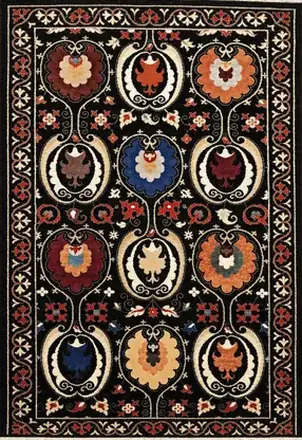
A hand-knotted pictorial rug from Latif Enterprises, with peacocks at its corners and songbirds in a cage at its centre on a gold and black ground, shown first in raw undyed wool and then in full colour as the dyes come into the pile.
Our Craft · I & II. The Wool and the Dye
We use hand-spun Ghazni wool, chosen for staple length, strength and natural lustre. Those qualities decide whether a rug still looks like this in thirty years, and they are settled before the first knot is tied.
Madder root for red, indigo for blue, walnut husk for brown. Natural dyeing is slower and less predictable than the chemical kind, and the slight variation from one dye lot to the next is what collectors look for.
Hand-spun yarn is slightly uneven, which is why a hand-knotted rug catches the light the way it does. Machine-spun yarn is perfectly regular, and you can see it.
A hand-knotted rug from Latif Enterprises on the washing floor: a deep navy field with a large ivory and turquoise medallion inside a cream border, shown dull off the loom and then washed clean and fully saturated.
Our Craft · IV & V. The Wash and the Finish
A finished rug comes off the loom dull. Washing opens the wool and the colour arrives, which is the moment everyone in the workshop comes to watch.
Shearing levels the pile with flat steel shears, a few millimetres at a time. It is the slowest way to do it and the only way to keep the pattern crisp at the edges.
The water from this floor goes to the treatment plant the family built in 2006, the first tannery in Pakistan to have one of its own. It was built because pouring dye water into the ground is wrong. No buyer asked for it.
Six kinds of hand-knotted rug from Latif Enterprises, shown as a stack thrown back one at a time: a ruby Persian-style traditional rug, an ivory silk-ground rug with small flowering branches, an indigo Afghan Kazak with large geometric medallions, a sand and rust Ziegler, a fuchsia over-dyed rug, and a modern abstract rug in charcoal, ochre and sienna.
What We Make · Hand-knotted rugs
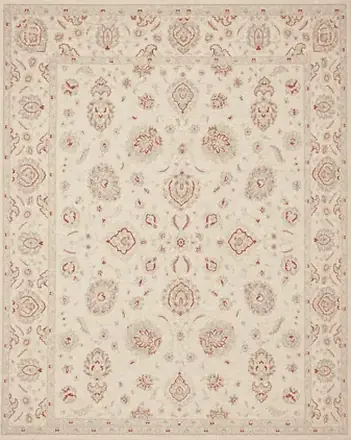
Classical Persian drawing: a central medallion, corner spandrels and a field of scrolling vines, knotted fine and dense. Every rug is made on our own looms in Lahore, in any size up to a full room.
The field is silk and the flowers on it are wool, so the ground catches the light one way and the pattern another. Paler, finer and slower to knot.
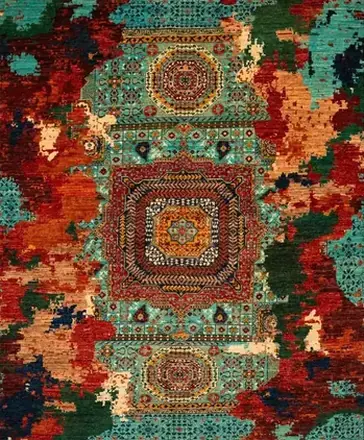
Big geometric medallions in thick hand-spun wool. The small shifts of colour across the field come from the yarn itself, and nobody tries to even them out.
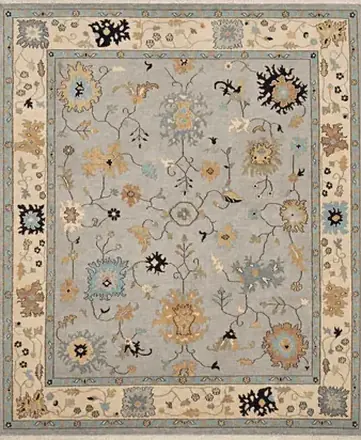
Large, open vines and palmettes in sand, rust and slate. A pattern that sits back in a room rather than taking it over.
A classical design taken down to one strong colour. The pattern is all still there, carried in tone instead of in colour.
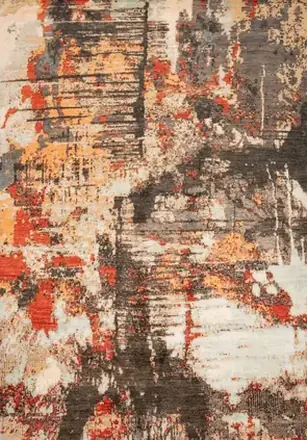
Abstract designs, knotted exactly the way the classical ones are. Bring your own drawing and we will weave it.
A very finely knotted rug from Latif Enterprises in wool and silk: a deep midnight-blue field with an intricate medallion and an all-over pattern of small palmettes and flowering vines in ruby, ivory and sky blue, its near corner turned back to show the grid of knots on the reverse.
Quality · The two checks
The back shows the knot count and whether the rows are even. Both are set by the weaver's hand as the rug is tied, and neither can be corrected afterwards.
Light along the surface finds any dip in a pile: a slack row, a dropped knot, a patch shorn too far. It is the last thing a rug goes through here.
Both take time, and both happen before a rug is wrapped, so the rug that arrives is the rug we checked.
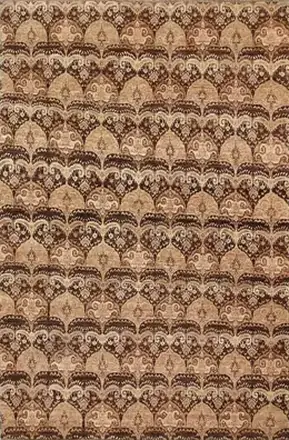
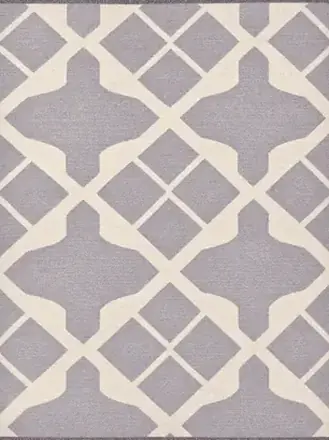
A rug from Latif Enterprises in completely undyed wool, in the natural colours of the sheep: ivory, oatmeal, soft grey and dark brown, in a calm geometric design of stepped diamonds, lying still while the light of several days passes over it.
Responsibility
Hand-knotted wool is used for decades and then handed on. The wool and the knotting settle that, long before anybody writes anything about it.
Its colours are the sheep's own: ivory, oatmeal, grey and brown. When we do dye, it is madder root, indigo and walnut husk, and the water they leave goes through our own plant before it goes anywhere.
Our group's tannery was the first in Pakistan to tan without chromium and the first to build its own waste-water plant, in 2006. It is rated Gold by the Leather Working Group, certified to ISO 9001, and audited by Inditex and IKEA. The water from our carpet washing floor goes through that same plant.
A hand-knotted runner from Latif Enterprises, long and narrow, with an ivory field of small scattered palmettes in soft red, blue and gold, carried a hand's width above a floor drawn as a map, travelling away from a mark where Lahore is.
Global Reach
Every rug here is knotted in our own workshops in Lahore, and then it travels. The mark on the floor is where all of it starts.
Our group's leather goes to Inditex, IKEA, Decathlon and Alpinestars, and leaves through Karachi and the Lahore dry port for North America, Europe and Asia.
Since 2024 our rugs have gone to homes in the United States straight from our looms in Lahore, with no importer in between.
A hand-knotted rug from Latif Enterprises on the loom in Lahore, madder red, ivory and indigo, with a weaver's two hands tying a knot at the top of the finished rows, where the bare cotton warp threads run up the loom, the camera closing until the single knot fills the frame.
The Artisans
A rug is six to twelve months of one person's working life. Some of the weavers on our looms learned from a parent who learned from a grandparent.
Every weaver on our looms is an adult and is paid a fair wage, and we enforce that across every facility we work with. We have turned down work that would have required otherwise.
You can write a design down. You cannot write down the tension, the trim or the judgement of when a row is right; a weaver learns those from another weaver at the loom.
A hand-knotted rug from Latif Enterprises, seen from above and dead centre in a bright room: a tree of life with roses, pomegranates and birds on a deep navy field, framed in turquoise inside a wide madder-red border.
The Road Ahead
More looms, better wool, buyers in the United States. The method has not changed and we have no plan to change it.
We export hand-knotted rugs made at volume, for buyers who want to know exactly where each one came from. Custom sizes, custom designs, and our own collections.
Exporter
Start a conversationLoading